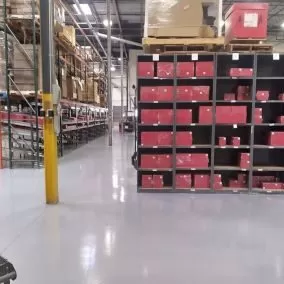
Cold storage and temperature-variable distribution facilities present flooring challenges that go beyond what standard warehouse environments create. Temperature transitions, condensation management, and the specific mechanical demands of refrigerated operations require careful system selection. Warehouse epoxy flooring can perform excellently in these environments when specified correctly for the conditions.
What Makes Cold Storage Flooring Different?
Cold storage environments subject flooring to thermal stresses that room-temperature warehouses don't experience. Concrete slabs in refrigerated spaces contract significantly compared to their dimensions at room temperature. In facilities with adjacent ambient and refrigerated zones, that differential creates stress at the transition boundary. Floor coatings that can't accommodate that thermal movement crack and delaminate at the zone boundaries over time.
Beyond thermal movement, cold storage and temperature-variable facilities experience condensation at floor level when workers or equipment move between temperature zones. That condensation creates intermittent wet surface conditions that affect traction. And the cleaning protocols for food-grade cold storage facilities are often more aggressive than those used in ambient warehouses, requiring coatings with high resistance to the specific chemical agents used in food-safe sanitation programs.
Which Epoxy Systems Work Best in Cold Storage Applications?
Standard epoxy formulations have a minimum application temperature requirement, typically around 50 degrees Fahrenheit, that makes installation in active cold rooms impractical without warming the space first. More importantly, the flexibility of the cured epoxy system matters for thermal cycling performance. Standard rigid epoxy can develop micro-cracks in environments that experience large temperature ranges.
For cold storage applications, system specification should involve contractors with genuine experience in temperature-variable industrial environments. The specific resins, topcoat formulations, and application conditions all need to be matched to the actual temperature profile of the facility. This is not a context where a generic epoxy specification developed for ambient warehouses can be directly applied without modification.
How Does Condensation Affect Warehouse Epoxy Flooring Performance?
Condensation at floor level is a real traction management challenge in facilities where workers and equipment move between temperature zones. As cooler surfaces come into contact with warmer, more humid air, moisture condenses on the floor surface. On a smooth epoxy surface without appropriate texture, that condensation layer significantly reduces available traction.
The solution is ensuring that epoxy systems in temperature-variable zones include anti-slip texture profiles appropriate for wet surface conditions. Broadcast aggregate systems or topcoats with embedded non-slip particles maintain traction even when the surface is intermittently wet from condensation. That texture needs to be specified with the condensation scenario in mind, not just for dry-condition performance.
What Cleaning Chemicals Are Used in Cold Storage That Affect Epoxy?
Food-grade cold storage facilities use aggressive sanitation protocols that involve chlorinated cleaning agents, quaternary ammonium compounds, and peracetic acid solutions. These chemicals are significantly more aggressive than the neutral-pH cleaners appropriate for ambient warehouse epoxy maintenance. Coatings not designed to resist them will show surface degradation within months of regular sanitation cycle exposure.
A warehouse epoxy flooring system for cold storage needs to specify topcoat chemistry that's been tested for resistance to the specific sanitation chemicals used in the facility. Contractors with food service and cold storage experience understand this requirement and can specify systems that meet it. Those without this background may not even know to ask about sanitation chemical compatibility.
A Practical Example From a Food Distribution Context
A Southern New Jersey food distribution facility operating both ambient and refrigerated zones needed flooring that could handle the transition areas where temperature differentials created regular condensation. The facility also used peracetic acid-based sanitizers on a daily cleaning cycle across the refrigerated zones.
After a thorough assessment including chemical compatibility review and thermal cycle analysis, the specification called for a flexible-modified epoxy base coat in the refrigerated zones, a peracetic acid-resistant topcoat formulation, and anti-slip texture throughout the transition and refrigerated areas. The result was a floor system that handled both the mechanical demands of the operation and the chemical exposure of the sanitation program without surface degradation.
How Are Transition Joints Between Ambient and Cold Zones Treated?
The boundary between ambient and refrigerated zones in a temperature-variable warehouse requires special attention. This is where the greatest thermal differential and associated slab movement occur. Standard semi-rigid polyurea joint fillers are appropriate for controlled-temperature warehouse joints, but the transition boundary between dramatically different temperature zones may need a more flexible specification to accommodate the greater movement range.
Experienced contractors assess the specific temperature differential at transition boundaries and specify joint filler flexibility accordingly. Missing this detail leaves the transition boundary as a point of recurring failure that undermines the performance of the surrounding floor installation.
What Should Facility Managers Specify for Cold Storage Epoxy?
When specifying warehouse epoxy flooring for cold storage or temperature-variable facilities, the specification document should explicitly address minimum application temperature requirements, cured-film flexibility characteristics, chemical resistance testing results for the specific sanitation chemicals used, anti-slip texture specification for wet surface conditions, and thermal cycling performance data.
Contractors who can respond to these specification requirements with documented product data and real project experience in comparable cold storage environments are the appropriate partners for this application. This is not the context for a contractor whose primary experience is in ambient warehouse or commercial environments.
Conclusion
Warehouse epoxy flooring performs well in cold storage and temperature-variable environments when the system is correctly specified for those conditions. Thermal cycling performance, condensation-condition traction management, and compatibility with food-grade sanitation chemicals all need to be explicitly addressed in the specification. Working with contractors who have documented experience in cold storage applications ensures those critical requirements are built into the project from the start.